.png&w=1280&q=75)
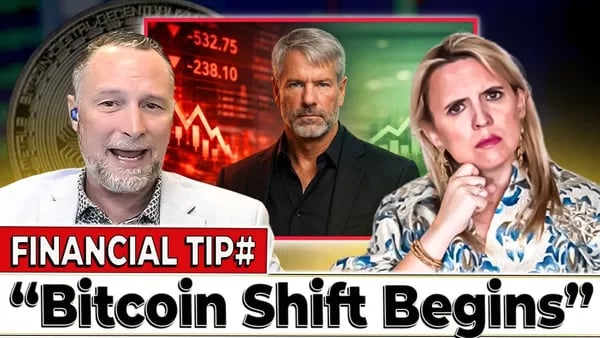



I remember sitting in a living-room-style studio with Eric Runge, thinking: I barely understand Bitcoin, but I know disruption when I see it. Between my law-degree instincts about government overreach and Eric's 20+ years in finance, the conversation turned into a crash course — dogs barking in the background, real-world mortgage anecdotes, and enough historical context to make the case that Bitcoin isn't just a headline. In this short post I’ll walk you through what Bitcoin fixes, how I’d think about it in a portfolio, and what the near-term (2026) picture looks like — all in plain language and a few human asides.
1) Why I care: a messy, human primer
Bitcoin 2026 starts for me with a very normal, slightly chaotic moment
When I think about my Bitcoin 2026 view, I don’t start with charts. I start with a memory: hosting Eric Runge on Financial Mastery Simplified (FMS.tips, FMS.college), trying to keep the conversation moving while my brain was still catching up. I remember saying, honestly, that I didn’t totally understand Bitcoin yet. That wasn’t a branding move—it was real curiosity mixed with confusion. And yes, there were dogs in the background, because real life doesn’t pause for “serious finance.”
Eric was calm and clear. He’s been in finance for 20+ years, based in Madras, Oregon, and he admitted something that surprised me: he never felt like he fit in the retail world of “just slinging stocks and bonds.” Bitcoin, for him, wasn’t a product first—it was a personal passion that later became professional.
My core takeaway: disruption isn’t just price—it's incentives
I’ve said it out loud before, and I still mean it:
“Bitcoin is kind of a fascinating thing to me because first of all, I kind of like anything that disrupts spaces.”
That disruption framing matters, especially for non-technical people. It helps you see Bitcoin’s role beyond price candles and hype. For me, Bitcoin “invited” me in because it challenges the incentives created by fiat money—especially when bailouts feel broken, uneven, or politically convenient. It’s philosophical and practical: a system that tries to reduce the need for trust in the people running the money.
And yes, my law degree is part of this. Watching lockdown-era power expand—and how quickly freedom can shrink—made me more sensitive to the link between monetary power and incentives. I’m not saying Bitcoin fixes everything. I’m saying it made me ask better questions about who benefits, who pays, and who gets rescued.
Why an education-first Digital Asset approach shapes my Bitcoin Outlook
Eric said something that stuck with me because it matches how I try to run every brand I touch, including House You (homeownership education):
“If they own it or never own it, I've done my job if I can talk to them about it in a way that they understand it.”
That’s the tone I want for this Bitcoin Outlook. Research and experience both point to the same thing: expert voice + education-first lowers anxiety and improves decision-making. People don’t need a pep rally. They need a map.
Educate: What is Bitcoin, and what problem is it trying to solve?
Equip: How do custody, position sizing, and downside risk mitigation work?
Empower: Make a choice—own it, don’t own it, but do it with eyes open.
That’s how I think about Bitcoin as a Digital Asset: not a religion, not a lottery ticket—just a set of trade-offs worth understanding.
2) History: the actual problem Bitcoin tries to solve
From gold standard to fiat: incentives changed in 1971
When I build my Bitcoin Outlook, I start with the problem Bitcoin was designed to answer: what happens when money can be created without a hard limit, and when the system expects rescues during stress?
In 1971, President Nixon temporarily delinked the U.S. dollar from gold. Before that, dollars were tied to a fixed amount of gold, which acted like a constraint. After the shift to fiat currency, the constraint became policy and politics. As described in the conversation, inflation then jumped to roughly ~10% per year for about five years. Over the long run, purchasing power erosion became the quiet baseline risk that households and investors had to manage.
Key date | What changed | Why it matters for Market Structure |
|---|---|---|
1971 | Dollar unpegged from gold | Money supply became more flexible; incentives shifted toward debt and discretionary support |
2008 | Global financial crisis | Bailout expectations hardened; trust in institutions weakened |
2009 | Bitcoin released | A new Digital Asset with fixed supply rules enters the system |
Historical purchasing-power data helps frame why investors keep searching for risk-on assets like stocks, real estate, and crypto. One simple illustration: from 1913–2020, the U.S. dollar lost roughly ~90% of its purchasing power (often shown with examples like far more candy bars per $1 in 1913 than in 2020). Even if the exact basket changes, the direction is clear: cash is not designed to hold value forever.
2008–2009: Bitcoin as a response to bailout-era behavior
Bitcoin didn’t appear in a vacuum. It arrived right after the 2008 crisis, when bailouts and emergency programs made the “rules” feel optional for the biggest players. That context is literally embedded in Bitcoin’s origin story. As Eric Runge put it:
Eric Runge: "The very first block... was 'Chancellor on the brink of second bailout for banks.'"
That headline, placed in Bitcoin’s genesis block, reads like a mission statement: a system where settlement does not depend on a bank’s balance sheet, and where supply is not expanded to patch over systemic mistakes. This is the core “why” behind Bitcoin as a Digital Asset: it is a counter-system to fiat incentives and systemic bailout behavior.
Technical lineage: digital cash attempts before Bitcoin
I also think it’s important to say Bitcoin wasn’t the first digital-cash idea. It was the first to combine prior research into a working design that could survive in the wild—especially around double-spending, network consensus, and incentives for participants to secure the system.
Eric Runge: "By the time 2009 rolls around, Satoshi has basically solved all of the problems that the previous generations couldn't handle, and he releases Bitcoin."
In Market Structure terms, Bitcoin introduced a new kind of asset: one with transparent issuance, predictable rules, and settlement that doesn’t require permission. That is the actual problem it tries to solve—credibility in money and settlement when trust in institutions is strained.
3) How I’d (and Eric does) think about Bitcoin in a portfolio
Start with the “why”: purchasing power and incentives
My baseline view is simple: when government debt and spending rise fast, the U.S. dollar tends to lose purchasing power over time. That pushes families and institutions to take more risk—stocks, bonds, real estate—just to keep up. Bitcoin fits into that same “keep up or outpace debasement” bucket, but with a different Market Structure: fixed supply, global liquidity, and no central issuer.
That doesn’t mean Bitcoin is “safe.” It means it can be a portfolio tool for long-term purchasing power, if the position size and custody choices match the client’s real risk tolerance.
Practical placement: small, responsibility-focused allocations
Eric Runge has spent 20+ years in financial planning, and his current professional focus is helping family offices integrate Bitcoin with downside awareness—not hype. I think about it the same way: start small, earn the right to add, and treat the allocation as a responsibility.
Size it to survive volatility: if a drawdown would force a sale, the allocation is too big.
Define the role: is it a long-term purchasing power hedge, a non-sovereign reserve asset, or a diversifier?
Plan the operational details: custody, rebalancing rules, and who has authority to move coins.
Education-first onboarding (before any buy button)
Eric’s model is education-led, and I agree with that approach. He measures success by understanding, not adoption:
Eric Runge: “I work with family offices, helping them responsibly buy Bitcoin, understand it.”
Eric Runge: “Basically, if they own it or never own it, I’ve done my job if I can talk to them about it in a way that they understand it.”
In practice, education means clients can explain (in plain language) Bitcoin’s volatility, the custody trade-offs, and the philosophical case for a scarce digital asset. Research also supports this: education + custody solutions reduce behavioral selling and increase long-term retention. If people don’t understand what they own, they tend to sell at the worst time.
Tools & services that change sell-side pressure and liquidity
Where 2026 feels different is Institutional Demand meeting improved rails. ETFs, strategic reserves, and better custody options can materially change the supply-demand math. When large pools of capital arrive through familiar wrappers, ETF Flows can become a steady bid that competes with new supply and weak-hand selling.
ETFs: simplify access for institutions that can’t (or won’t) self-custody.
On-chain vaults and custody: clearer controls, policies, and auditability reduce operational fear.
Tokenization and modern settlement: can improve liquidity pathways and collateral use over time.
Strategic reserves: reduce circulating supply if held with long time horizons.
A simple decision checklist I use
Allocation: small enough to hold through a major drawdown.
Custody: ETF vs. qualified custodian vs. self-custody—chosen intentionally.
Education: the client can explain the thesis and the risks.
Process: written rules for adds, trims, and rebalancing.
4) Bitcoin 2026 outlook: predictions, numbers, and wild cards
When I map out Bitcoin 2026, I start with one simple idea: Bitcoin does not negotiate with headlines. As Eric Runge put it,
"It just keeps confirming blocks, and that's what Bitcoin does."
That steady, rules-based behavior is why many analysts think the Institutional Era is the main story for 2026, especially in a Post-Halving market where new supply is already tighter.
Consensus view: New Highs powered by ETF Flows
Across research and commentary from groups like Bitwise, Grayscale, and major financial media, the most common 2026 bull thesis is straightforward: New Highs are likely if ETF Flows stay strong and more platforms make access easier. In my view, this is less about retail hype and more about steady allocation behavior—advisors, model portfolios, and institutions that buy on schedule and rebalance over time. Grayscale’s broader point about a sustained bull market with rising valuations across crypto sectors fits here, because liquidity and participation tend to widen once institutions commit.
Price Forecasts: use ranges, not a single number
I don’t treat Price Forecasts as a single target. I treat them as scenarios. The “mainstream” cluster I see most often sits around $120K–$170K for 2026, while more aggressive calls reach as high as $400K (as cited across outlets like IG, Business Insider, and industry research). My base case assumes continued ETF demand and improving market structure, but also assumes sharp pullbacks along the way. The high-end case assumes a supply squeeze plus a strong macro tailwind.
Macro and policy tailwinds that can reduce sell pressure
Policy matters most when it changes flows. If the Fed moves into rate cuts in 2026, risk assets can benefit at the margin, and Bitcoin often reacts fast to easier financial conditions. I also watch the idea of a US strategic reserve—often cited around ~233,000 BTC—because removing coins from potential sell-side circulation can tighten supply. On top of that, evolving legislation (including talk around the CLARITY Act and shifting signals from a Trump administration) could reduce uncertainty for institutions that need clear rules before they scale.
The wild card: ETFs buying more than 100% of new supply
The scenario I take most seriously is the “math problem”: what if ETFs and institutions buy more than 100% of newly mined Bitcoin for long stretches? In that case, price can move quickly because the market must pull supply from existing holders, not miners. That is when rallies can look irrational, even if the driver is simply constrained supply meeting steady demand.
My takeaway is practical: I plan for volatility, keep position sizes modest, and focus on the institutional drivers—ETFs, custody, liquidity, and policy—because those are the levers most likely to shape Bitcoin 2026 outcomes.
